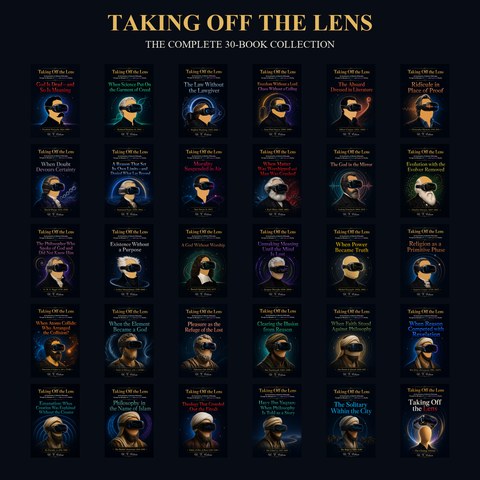
Book 01
God Is Dead — and So Is Meaning
Enter Nietzsche's strongest case before testing whether meaning can survive the death of God that his philosophy announced.
Veluna Press · Thirty books · Twenty-nine thinkers
Meet each thinker on his strongest ground. Put the lens on, see what it reveals, then follow the argument until the image enlarges and its limits appear. Thirty browser-native books on philosophy, fitrah, and what reason can — and cannot — establish alone.
Book One is free. Books Two through Thirty stand alone and may be read in any order. Book Thirty is also the integrative closing volume.
Book 01
Enter Nietzsche's strongest case before testing whether meaning can survive the death of God that his philosophy announced.
Book 02
A careful distinction between empirical science and the worldview sometimes presented in its name.
Book 03
What physical law explains, what it presupposes, and why an equation describing a beginning is not yet an account of why anything exists.
Book 04
Radical freedom is granted its full force, then followed into the burden and instability produced by a world without a given human nature.
Book 05
Camus's luminous refusal of despair, examined alongside the meaning his prose inhabits while his philosophy declines to name it.
Book 06
A study of the point where wit, confidence, and moral outrage begin doing work that evidence was supposed to do.
Book 07
The skeptical method is applied consistently until causation, the self, reason, and ordinary daylight all come under pressure.
Book 08
A boundary drawn around human knowing, and the question of whether the boundary describes reality or only the instrument doing the knowing.
Book 09
Can science determine what ought to be, or does every moral landscape begin with a value the instruments did not supply?
Book 10
A material account of history is tested against the person, the moral claim, and the human cost that matter alone cannot weigh.
Book 11
If God is a projection of human longing, what explains the standard by which the projection is recognized as false?
Book 12
Evolutionary mechanism is kept distinct from the larger metaphysical verdicts later attached to it.
Book 13
A system that makes history intelligible and speaks often of God, while transforming the Living One into a movement of thought.
Book 14
The will beneath appearances, the suffering it produces, and the purpose quietly required to judge existence as a mistake.
Book 15
A necessary God identical with nature is examined at the point where necessity leaves no One who hears, wills, or can be worshipped.
Book 16
The instability of signs is taken seriously, then tested against the truth claims required to declare every stable meaning suspect.
Book 17
What happens when every claim is read through power, including the claim that power explains what passes for truth?
Book 18
The ladder from theology to positive science is examined together with the secular religion Comte built at its summit.
Book 19
An ancient material universe of atoms and void, pressed on order, causation, consciousness, and the source of intelligibility.
Book 20
The first material principle marks a decisive achievement, but composition is not yet origin and a substrate is not yet a Creator.
Book 21
A disciplined search for tranquility is examined where freedom from fear also removes judgment, purpose, and final accountability.
Book 22
A critique of philosophical abstraction and a defense of sound reason, fitrah, and revelation without making reason their enemy.
Book 23
Philosophy is challenged from within its own methods, then examined at the line between intellectual victory and certain knowledge.
Book 24
The Necessary Existent is followed from proof to abstraction, where the God reached by demonstration risks becoming distant from worship.
Book 25
A cascading metaphysics of intellects and spheres is tested against creation, will, and direct knowledge of the One who creates.
Book 26
The attempt to reconcile Aristotle with revelation is read in its strongest form and tested where interpretation begins to govern the text.
Book 27
A formidable theological intellect is examined where proliferating arguments can obscure the recognition they were meant to defend.
Book 28
A solitary mind reasons from nature toward God, revealing both the reach of reflection and what the thought experiment already assumes.
Book 29
The solitary thinker seeks perfection inside an imperfect city, raising whether truth belongs only to the philosophically trained.
Book 30
Twenty-nine lenses have been put on and taken off. The closing volume identifies the recurring structure and turns the method on itself.
“There is one more lens, and you have been wearing it the whole time.”
BOOK 30 · CHAPTER ONE
Free, complete, right here in your browser. Once opened it stays readable offline.
Checkout takes a minute. Your personal key arrives by email, signed to your name.
The books unlock on this device and read offline. No account. Yours for good.
Also from Veluna Press
Dear Musk follows seven questions through rockets, artificial intelligence, civilization, truth, mind, and accountability. If this collection examines one thinker at a time, the letters test the same first principles inside the technologies shaping the present.
One tap sets everything below. Fine-tune freely afterwards.
Preparing…